One More Round: The Unwritten Magic of Staying Just a Little Longer
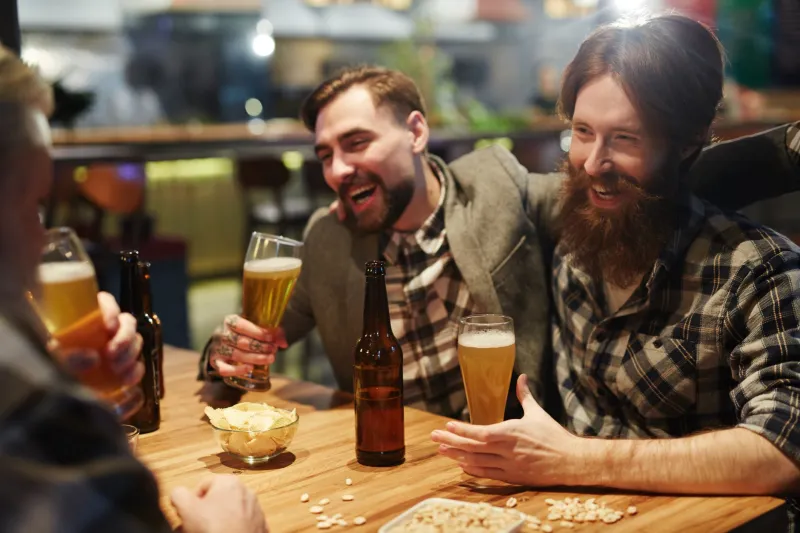
You had a plan. Two drinks, maybe a plate of something, home by ten. Responsible. Adult. Entirely reasonable.
And then somebody said it.
One more round.
Suddenly your jacket's back on the hook, the glasses are getting refilled, and whatever urgent thing you had waiting at home — the laundry, the early morning, the very sensible bedtime — just quietly agrees to wait a little longer. There's a reason that moment feels so good. And it's not just the beer.
The Shift Nobody Plans For
Every night at McCoy's has a rhythm. People arrive, settle in, shake off whatever the day threw at them. The first drink is almost transactional — it's the decompression valve, the thing that signals to your nervous system that the workday is genuinely over. The second one is where conversation actually starts. You stop talking about your day and start just... talking.
But that third round? That's where the real night begins.
Something changes in a room when a group decides collectively to stay. The energy tightens up. Voices get a little louder, not because anyone's trying, but because the walls between people have quietly come down. New conversations bleed into old ones. The couple at the next table who you've been half-aware of for an hour suddenly becomes part of your orbit. The bartender starts calling you by name — or at least, by your drink.
Psychologists who study social bonding talk about something called "shared experience synchrony" — the idea that people feel closer when they're experiencing the same thing at the same time. A pub in its later hours is basically a masterclass in it. Everyone at that point has made the same choice: to stay, to be present, to lean into the night rather than cut it short.
What Makes Someone Say Yes
Think about the last time you agreed to another round when you genuinely hadn't planned on it. What tipped the scale?
Most people, if they're honest, will point to something small. A story that was mid-sentence. A song that just came on. The way the group was laughing — that specific kind of laugh that you don't want to be responsible for ending. Sometimes it's as simple as not being ready to give up the version of yourself that only shows up after nine o'clock.
There's a looseness that comes with a good pub night that's genuinely hard to find anywhere else. You're not performing. You're not networking. You're not optimizing anything. You're just there, in a booth or at the bar, with people you like, doing absolutely nothing particularly productive — and somehow it's the best you've felt all week.
The "one more round" moment is basically your subconscious recognizing that and refusing to let it go.
How the Bar Changes as the Night Gets Older
If you pay attention, a pub like McCoy's actually transforms over the course of an evening. The early crowd is a little more self-contained — people in their own bubbles, heads down over menus, conversations kept close. By mid-evening, those bubbles start to overlap. By the time the later rounds are flowing, the whole room has reorganized itself into something looser and more communal.
The bar itself becomes more social real estate than just a place to order drinks. People lean on it differently. Stools get abandoned in favor of standing, which makes it easier to drift in and out of conversations. The staff shifts gears too — less focused on the mechanics of service, more in the rhythm of the room.
Food orders get more spontaneous. Nobody planned on splitting a basket of fries at 10:30, and yet here you are, and they're somehow the best fries you've ever eaten. That's not a coincidence. Context changes flavor. Everything tastes better when you're relaxed and happy and exactly where you want to be.
The Signals You Might Not Even Notice
There are tells. Unspoken cues that a group is about to tip from a two-drink night into something more. The coats that were draped over chairs get moved to the back of the booth — nobody wants to look like they're about to leave. Phones come out less. Eye contact increases. Someone orders something that takes longer to eat, which is basically a physical commitment to staying.
And then there's the lean. You know the one. When someone shifts their weight inward, toward the table, toward the group — that's the body language equivalent of saying I'm not going anywhere. Watch for it next time you're out. Once you see it, you'll start noticing it everywhere.
The bartender usually knows before the table does. A good one can read the room well enough to know which groups are wrapping up and which ones are just getting started. It's not magic — it's pattern recognition built over years of watching people decide, night after night, whether to stay or go.
Why It Always Feels Like Starting Over
Here's the strange, wonderful thing about the extended pub night: the second wind doesn't feel like a continuation. It feels like a reset.
Something about committing to another round wipes the slate clean. The conversation that was starting to feel a little circular suddenly finds a new direction. The person you've known for years says something that surprises you. You laugh harder than you have in weeks at something that probably won't be funny in the morning.
That's the real gift of the comeback round. It's not just more time — it's a different quality of time. The earlier part of the evening was great, but it was still tinged with the residue of the day, the awareness of obligations, the low hum of everything else competing for your attention. By the time you're into that extra round, all of that has faded. You're just here. Fully, genuinely here.
Know When to Ride It, Know When to Call It
None of this is to say every night needs to be a marathon. Some of the best evenings at McCoy's are clean and compact — a couple of pints, a great meal, home at a reasonable hour feeling satisfied. There's no shame in the early exit. In fact, leaving on a high note is its own kind of art.
But when the night has that particular pull — when the group is locked in and the energy is right and someone floats that question across the table — it's worth pausing before you reach for your jacket. Not every evening earns a second act. The ones that do are worth staying for.
Because here's the truth: the stories you tell later are almost never about the first drink. They're about what happened after you decided to stay.